Hospitals create a hazardous materials plan laid out with details on possible sources of contamination, hospital evacuation, taking into account specific hospital characteristics and treatment strategies.
Decontamination of patients should serve two goals:
- Protect caregivers from the offending agent. Should a caregiver become affected, this not only removes her from her health provider role, but also increases the burden of the illness on the remaining caregivers. If the entire department becomes contaminated, the entire site may require quarantine.
- Protect patients from further injury by removing the offending agent from the patient.
Decontamination is complicated by the type of agent. Some can be easily removed by taking off the patients clothing and washing them in soap and waters. Others, such as nerve agents, may penetrate the skin and are more difficult to remove. Knowledge of the agent is helpful in this case
Zones of Decontamination at the Scene

- The hot zone is the area of exposure, “ground zero”. Entry into hot zones requires special equipment. Entrance to this area needs to be restricted to those wearing the proper protection equipment to prevent contamination of others. The shape of the hot zone is determined by the characteristics of the spill. For example, wind may spread contaminant downwind and therefore that area should be contained in the hot zone to prevent further decontamination of others. As such, entrance to the hot zone and other command and treatment areas should be upwind.
- The warm zone is a perimeter set slightly larger than the hot zone. Here is where decontamination and initial triage can occur. People within the warm zone are not in immediate risk of contamination, victims should be decontaminated here first before being moved to more secure areas.
- The cold zone is outside the area of potential contamination where treatment and transportation takes place.
Personal Protective Equipment (PPE) for providers
This is the clothing and masks that health care providers wear to prevent themselves from being exposed. The more complex equipment (masks, hazmat suits, respirators) require specialized training. The level of protection is broken down into three levels:
- Level A PPE is a fully encapsulated, chemically-resistant suit with a self-contained breathing apparatus (SCBA). This is usually worn at the site of the chemical exposure.
- Level B PPE has a full-face positive air-pressure respirator (PAPR), chemically resistant and protects against splashes. This is usually worn by the on-site personnel decontaminating patients. Health care workers dealing with an unknown contaminant will also wear level B PPE.
- Level C PPE has chemical-resistant clothing and an air-purifying respirator against airborne contaminants. This is usually worn when the chemical is known not to be at toxic levels, the oxygen level is 21% or greater.
Decontamination of patients
Skin exposures need to be decontaminated immediately. Clothing should be removed carefully (to avoid transferring contaminant to the skin) and properly disposed of. This is often best done outside the hospital by EMS. Tents and showers can be set up fairly quickly for this purpose. If it needs to be done inside, a decontamination room should be set up.
Example at Rush Medical Center

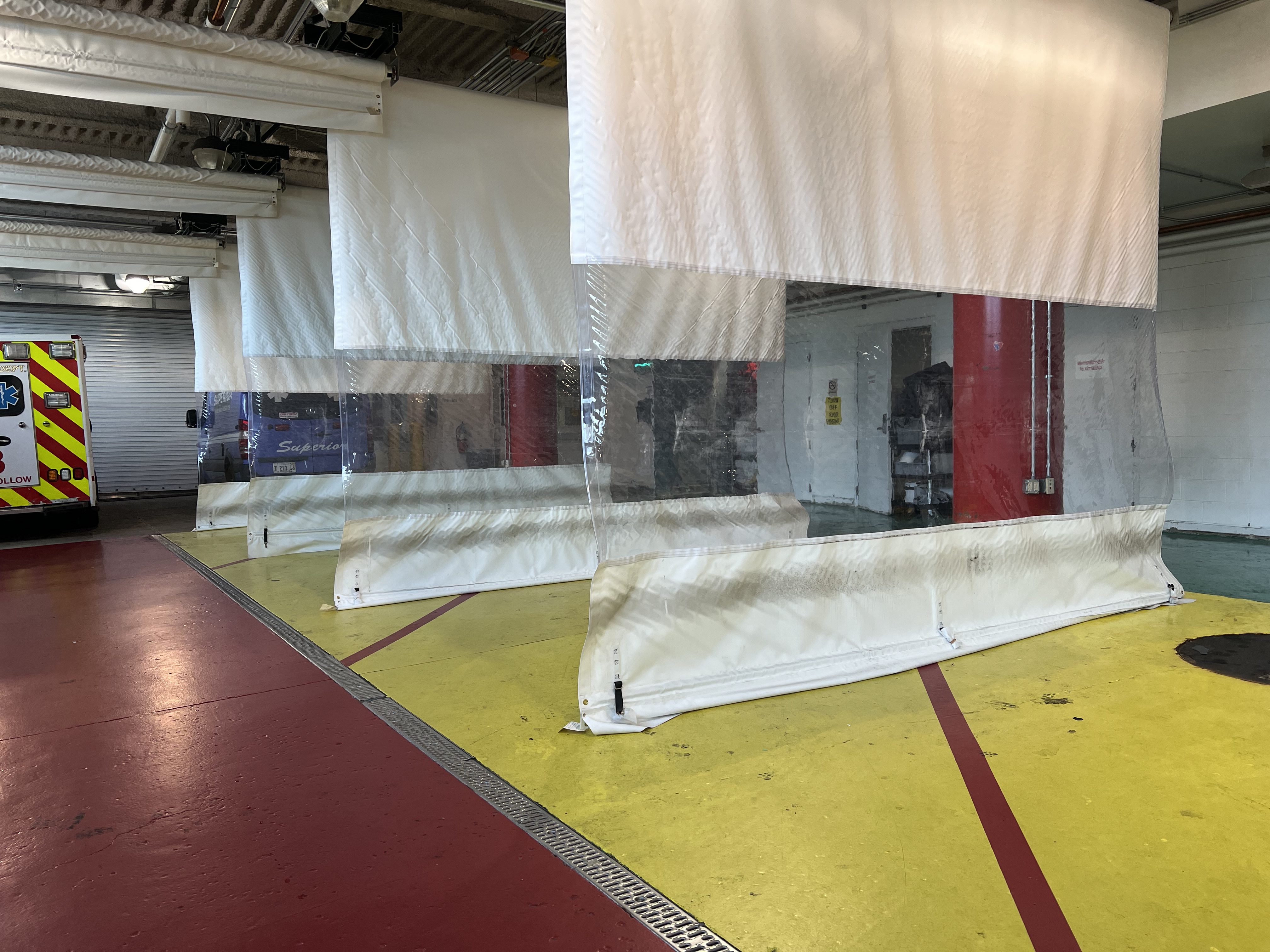
The Emergency Department and its ambulance bay at Rush Hospital has been specifically designed to manage disasters. There is water available for decontamination, heat lamps to warm up cold and wet patients after washing, and even a separate water collecting system to avoid putting contaminants back into Chicago’s watery supply. As shown above and below there are hot, warm and cold zones designated.


 patwari
You must be logged in to post a comment.